

Improving Safety by Evaluating Near Misses
Risk ManagementThroughout our lives, we develop knowledge and wisdom, in part, by learning from our mistakes and those of others. In the context of outdoor education and adventure programming, we learn from both catastrophic events and near misses — close calls. These are events in which nearly every factor necessary to cause serious injury or death is present but catastrophe is averted due to the presence or absence of one or more conditions.

For example, imagine starting a rock climbing route and then realizing, when you’re 20 feet up, that you failed to do a specific knot check. You look down and can’t see the knot because your puffy jacket or a feature on the rock is obscuring your view. You look up and see that you have to climb about 60 feet more feet to reach an area of safety, and you’re unable to let go of the rock to get a better view of the knot, so you decide to descend. Upon reaching the ground, you discover that your knot was only half-tied.
Eventually, you’ll ponder:
- Would you have made it to the top of the climb without falling?
- Would the half-tied knot have held?
- Would a possible fall have resulted in injury?
The possible outcomes are numerous and uncertain, but the near miss is obvious, as is the lesson to be learned — don’t forget to check your knots before starting your ascent.
As Close as the Width of a Slice of Swiss Cheese
You can think of a near miss as being as close to disaster as the width of a slice of Swiss cheese. Why Swiss cheese? Because it has (more…)
Protecting Your Food from Bears and Other Wildlife in the Backcountry
WildlifeOne of the best things about camping is eating, and you’re likely not the only one in the backcountry who appreciates fine camp cuisine. Any bear, racoon, coyote, skunk, possum, or other opportunistic scavenger close enough to pick up the scent might stop by for dinner or a late night snack.
And these moochers aren’t picky. They’ll settle for food, trash, even toiletries like toothpaste and soap. That’s why it’s so important to take precautions to protect your foodstuff — and yourself — from bears and other wildlife that might come calling.
Are bears a major safety concern in the backcountry? Only if you encounter them, and that depends on where you’re spending your time. As explained in our previous post, “Gauging Your Safety in the Wilderness: What’s the Most Dangerous Animal?” you’re most likely to run into bears in remote forested or alpine areas. But you should always be careful whenever you’re in an area bears are known to roam.
Explore Your Food Storage Options
Your type of activity and style of travel will determine the food storage system you choose. Here are several simple food storage options to consider:
- If you’re car-camping, simply return your food and cookware to your vehicle after a meal.
- If you’re at a campsite that provides food storage boxes, you can use one of those.
- If you’re on a paddling trip without any risk of encountering a bear, simply secure your food in a cooler with a good lid.
However, if you’re hiking in the backcountry, you’ll need to take some additional precautions. That means using specific food storage methods such as bear hangs or bear cans, and being intentional about how you arrange your campsite.
Using a Bear Hang
Bear hangs dangle your food bag out of reach of animals. They’re lightweight and require minimal equipment:
- Bear bag or stuff sacks to contain your food and scented items, such as toiletries
- 100 feet of rope or parachute cord
- One or two carabiners
- A weighted object, such as a stuff bag with a rock in it (a heavy carabiner can do the trick)
You can choose from several different bear hang techniques. Here’s the basic One-Tree Method:
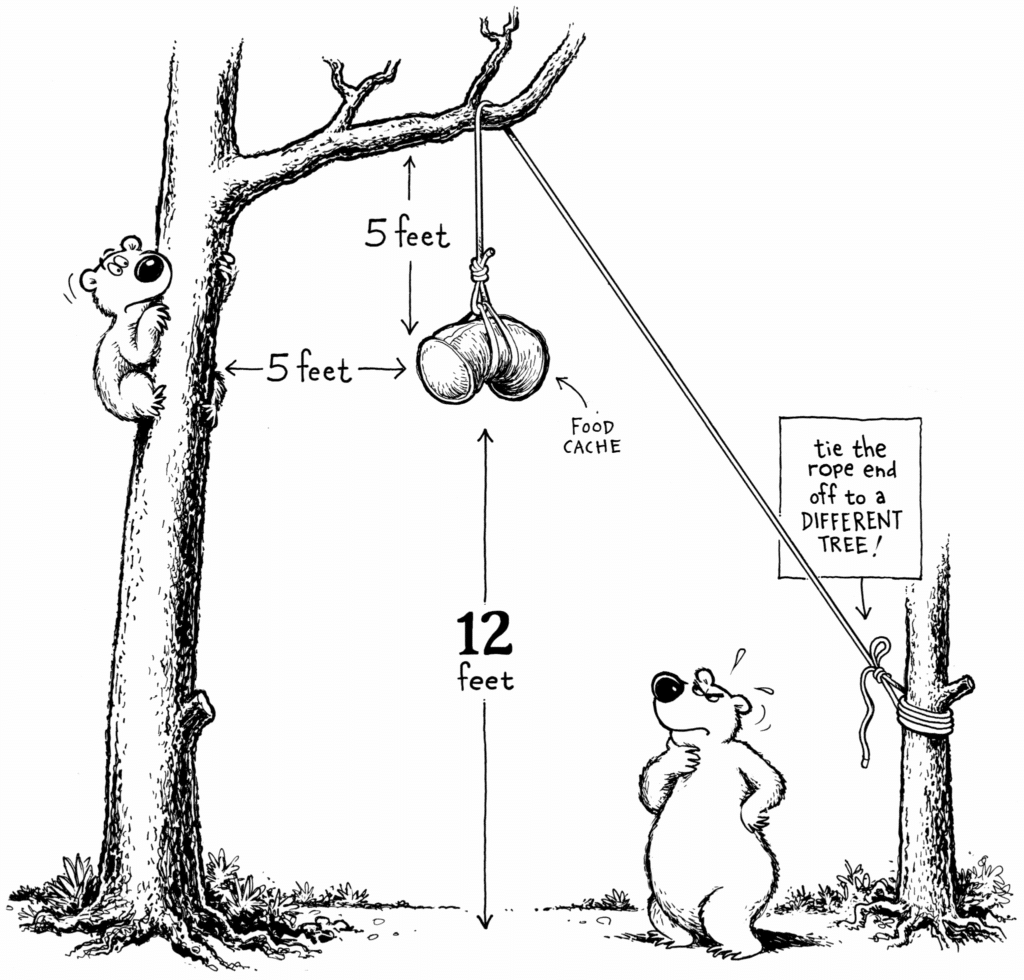
- Select a tree with a sturdy branch at least 15 feet off the ground and extending at least five feet out from the trunk.
- Tie one end of your rope to a weighted object, such as a carabiner or a stuff bag with a rock in it, and toss it over the branch.
- Clip the carabiner onto your food bags and pull on the opposite end of the rope until the bags are at least 12 feet off the ground and five feet from the trunk of the tree.
- Tie the end of the rope around the trunk of a nearby tree.
Safety precaution: Be sure nobody is standing in the direction the rope is being thrown or under the area the bag is hung.
This basic method works well in most areas; however, (more…)
TALK TO US
Have any further questions about our courses, what you’ll learn, or what else to expect? Contact us, we’re here to help!