

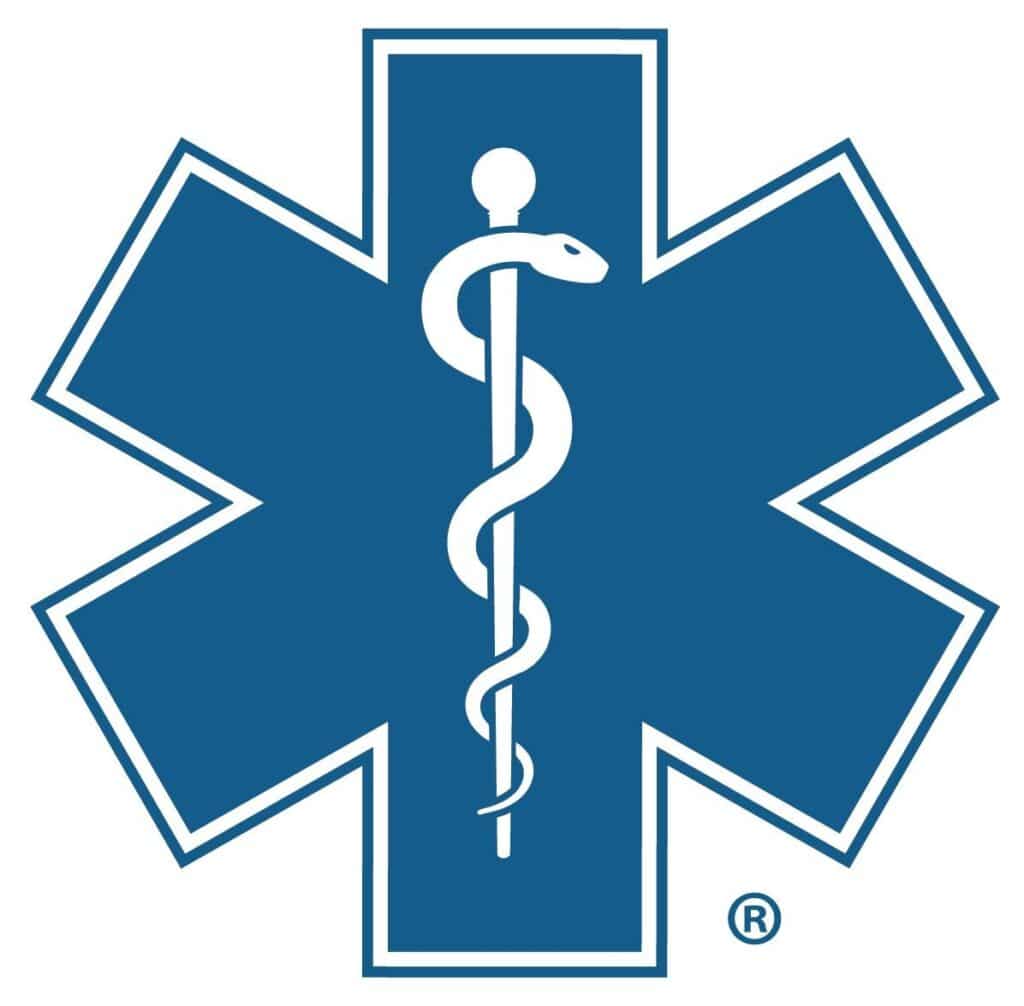
You’ve no doubt seen the symbol below painted on the side of an ambulance, embroidered on the uniforms of emergency medical technicians (EMTs), or stuck to emergency medical equipment. Maybe you even wondered whether it had any meaning. What’s with the snake coiled around the staff? What’s the significance of the six-pointed star?
The Origin of the Star of Life
Emergency Medical Services (EMS) was formed in the United States in the late 1960s around the realization that survival rates were higher on overseas battlefields than on U.S. highways. The high mortality rate on our highways was due, in part, to the lack of an organized system for responding to accidents and treating injured parties.
As emergency medical services were becoming standardized in the United States, the National Highway Traffic Safety Administration designed and later trademarked the blue, six-pointed Star of Life to serve as the official symbol identifying EMS personnel, vehicles, and equipment. The symbol was introduced largely because the Red Cross emblem is legally protected and could not be freely used on civilian ambulances.
The Symbol’s Meaning
The Star of Life features a blue six-pointed star outlined in white. In the middle is the Rod of Asclepius, which is an ancient Greek symbol that represents medicine and healing (the serpent represents healing in the form of shedding its skin).
Each of the six points of the Star of Life represents a function of emergency medical care, from detection, reporting, and response to on scene care, care in transit, and transfer to definitive care.
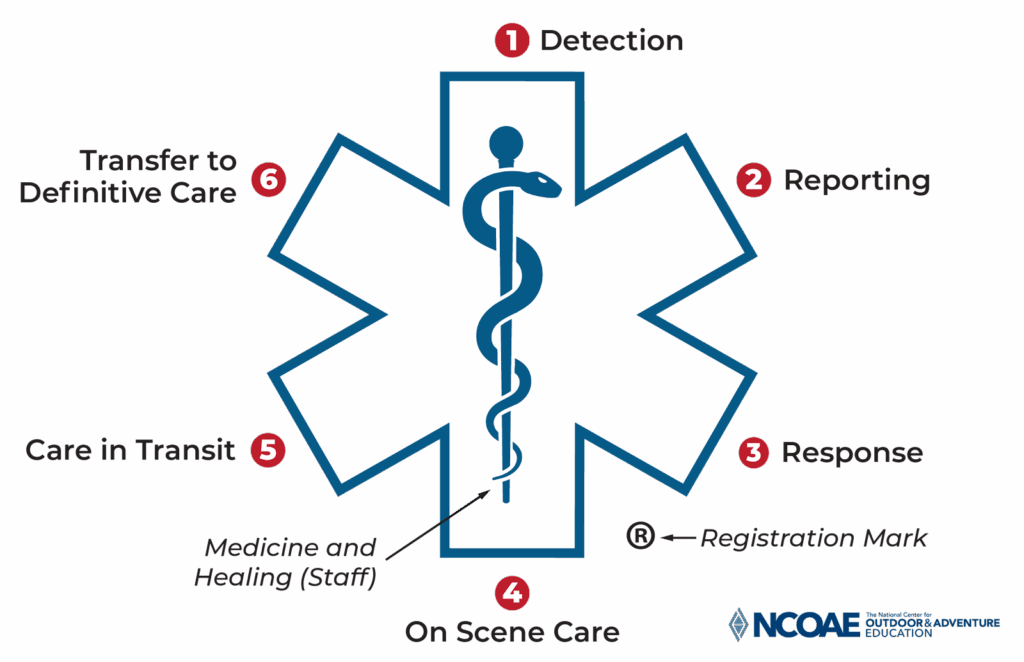
Here’s what you need to know about each of the six functions, starting with Detection:
Detection: When an emergency occurs, the EMS system is activated. Often this step entails the injured party or bystanders witnessing the incident and calling for help. A group of EMS practitioners called emergency medical responders (EMRs), often associated with fire departments, industrial settings, and service organizations are frequently positioned to recognize incidents immediately upon them occurring.
Reporting: After the incident is detected, its occurrence must be reported to the parties responsible for initiating a response. These calls for help are most frequently done with a telephone call using the (911) system. Less frequently, the reporting is conducted through emergency beacons or satellite communication devices, by radio after a phone call to a member of the emergency services community, or in person (by driving to a local fire department, for example). These methods typically inform a central communications center of the incident who then alert the EMS team.
Response: The response to the scene (location) of the incident is where the EMS’s “rubber meets the road.” The EMS practitioners, most commonly emergency medical technicians (EMTs), and advanced EMTs (AEMTs), and/or paramedics confirm receiving the call and then check enroute. The response may be “routine” or “emergency” depending on the information provided. Navigational search methods are employed in order to arrive at the proper location. Information is gathered and assessed, and plans are made about how to proceed on scene.
On-Scene Care: Upon arrival on scene, the responding EMS person must account for how the information provided compares to the facts found upon arrival. The patient is then approached, introductions conducted, and assessment provided. The assessments are then acted upon with care provided in the form of interventions such as medicine and procedures. Other interventions are delayed until after the transition to a higher level of care begins.
Care in Transit: It is frequently true that the most important intervention for a patient is rapid transport while mediating the risks of that transition from on-scene to hospital. Beyond the actual transport (movement to the hospital), care can be categorized as re-assessment, further interventions, and notification to the receiving facility.
Transfer to Definitive Care: The final function of EMS is to transfer the patient to a facility capable of providing more advanced and/or longer-term care. The process involves the physical movement of the patient from the ambulance to a facility bed, face-to-face reporting of patient findings, care, and results of interventions. Transfer of care concludes with gaining appropriate documentation of the transfer and the information related to the patient encounter.
The Symbol’s Function and Use
The Star of Life is more than just an attractive emblem. It has several practical applications, including the following:
- When displayed on uniforms and equipment, it helps the public easily identify qualified medical personnel. In 1970, when the American Medical Association’s Committee on Emergency Medical Services formed the National Registry of Emergency Medical Technicians (NREMT), the AMA chose the Star of Life to designate nationally certified EMS personnel.
- The symbol is often used on highway signs to indicate the location of emergency medical facilities or services, guiding individuals to locations where they can receive emergency care.
- The symbol may be used on medical identification tags and bracelets alerting emergency responders to specific medical conditions of the wearer.
- In the US, ambulances must meet federal standards to be permitted to display the Star of Life.
- Elevators marked with the symbol are large enough to hold a stretcher.
EMS is a relatively new division within the modern medical system. Its earliest start was disjointed and inconsistent. The Star of Life helped to shape it into a logical and effective system of care for responding to incidents with injuries, while at the same time serving as a symbol that’s easily recognizable to members of the medical community as well as the public at large.
If you’re interested in acquiring the skills necessary to qualify to work in the EMS sector, or if you’d just like to be as prepared as possible if and when a medical emergency occurs, considering taking one of our EMT Training Courses or Wilderness Medicine Trainings. Teaching people how to prevent and treat medical emergencies in urban, remote, and wilderness settings is among the things we’re known for here at The National Center for Outdoor & Adventure Education (NCOAE).
– – – – – – –
About the Author:Todd Mullenixis the Director of Wilderness Medicine Education at The National Center for Outdoor & Adventure Education in Wilmington, North Carolina.
TALK TO US
Have any further questions about our courses, what you’ll learn, or what else to expect? Contact us, we’re here to help!
Leave a comment