

Bob Weir, a founding member of the Grateful Dead, died on Jan. 10, 2026, hopefully reuniting with fellow band members who passed before him — Ron “Pigpen” McKernan (died in 1973), Jerry Garcia (died in 1995), and Phil Lesh (died in 2024).
I say, “Fare thee well,” in reference to one of their songs and to their 2015 Fare Thee Well tour celebrating 50 years of the Grateful Dead. Only two of the original Grateful Dead band members remain — drummer, Bill Kreutzmann and percussions, Mickey Hart.
Now you may be wondering, “What does a ’60s jam band have to do with The National Center of Outdoor & Adventure Education (NCOAE)? For that matter, how does music relate in any fashion with spending time in the backcountry?”
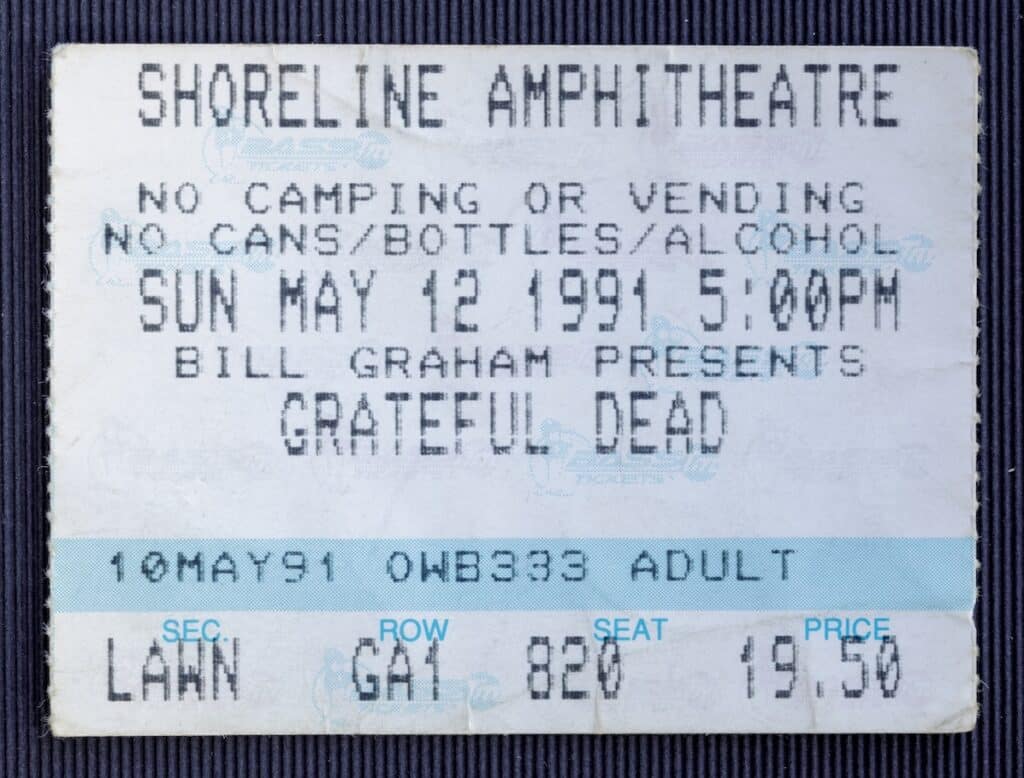
Mountain View, California – May 12, 1991 – Old used ticket for the concert of the Grateful Dead at Shoreline Amphitheater
Bob Weir’s passing, and my appreciation of his band’s music, reminded me of role music plays in outdoor culture for many members of our community. And this certainly isn’t the first time I’ve had this realization. A few years ago in this spåace, our Director of School Partnerships and Staff Development, Stephen Mullaney, shared playlists from several NCOAE team members in a post entitled, “The Quintessential Backcountry Expedition Road Trip Playlist.”
Some music genres and band types just seem to be more intricately intertwined with outdoor culture than others, and The Grateful Dead is definitely one such band. Other “jam bands” embraced by the outdoor community include Widespread Panic, Phish, String Cheese Incident, Leftover Salmon, and Goose.
So, what is it in particular about jam bands that resonates so well with outdoor culture? While it’s doubtful there are any formal studies into this phenomenon, I’m of the opinion that there’s a real cultural overlap. And as a longstanding member of the outdoor adventure and education community, I’d like to share my observations and insights.
Sharing Values With Jam Bands
Outdoor educators often gravitate toward jam bands because their values line up. Jam bands emphasize improvisation, long-form experiences, and being present in the moment. And that pretty much mirrors what outdoor education leaders care about.
Think about it. You carefully plan the route, and then comes weather, students, terrain, and energy levels that shape what actually happens. When you’re leading an expedition, you need to be flexible and creative, often improvising instead of following rigid protocols or procedures. External conditions, over which you have little to no control, often influence your decisions, choices, and behaviors.
As John Barlow, a lyricist who collaborated with the Dead, wrote, “…the music plays the band….”
Shared Relationship with Time
Jam bands and members of the outdoor community also share a relationship with time. Outdoor programs slow things down. Jam bands stretch songs, linger, and let things unfold. That pacing feels familiar to people who spend days guiding trips instead of watching clocks. The journey becomes more important than the destination. The experience transcends any schedule.
Strong Sense of Community
Community is another big area of overlap. From what my brother always told me, jam band scenes are tight-knit, welcoming, and built on shared experience rather than polish or perfection. Outdoor educators live in communities where trust, shared hardship, and storytelling are highly valued. Becoming transcends being. Self-improvement matters more than status. It’s not about who you are, but the process of achieving your full potential, that’s important. The purpose of community is to support members on their journeys and celebrate their achievements.
A Common Culture
Scene culture and substance use, without romanticizing it, are similar across jam band and outdoor recreation scenes, where experimentation, openness, and countercultural norms are common. Here at NCOAE, we discourage substance use and prohibit it in our expeditions and programs. Nonetheless, the fact remains that it’s a fairly common practice in outdoor culture.
A Low-Friction Lifestyle
Many outdoor educators came of age traveling seasonally, living out of vans, or bouncing between trail work, camps, and guiding jobs. Following bands like Grateful Dead or Phish fits that mobile, low-friction lifestyle.
As I think about the overlap between jam-band culture and the culture of those who choose to spend a lot of their free time in nature, I realize that it’s not so much about outdoor-types loving jam bands as it is about both worlds attracting people with the same values. These are people who value freedom, adaptability, and shared experience over polish and predictability.
If you have anything to add to this discussion. I’d love to hear it. Please post a comment below to share your thoughts. Let’s jam!
– – – – – –
About The Author: Zac Adair, MA, WEMT, is the co-founder and executive director of The National Center for Outdoor & Adventure Education (NCOAE), an AEE- and Cognia-accredited organization that designs and delivers unique outcomes-driven outdoor leadership and emergency care education that translates directly into credentials, careers, and academic credit.
TALK TO US
Have any further questions about our courses, what you’ll learn, or what else to expect? Contact us, we’re here to help!
Leave a comment