

If you’ve ever heard Led Zeppelin’s 1969 classic “Communication Breakdown,” you know how quickly things can go sideways when people aren’t on the same page.
In this case, the second greatest rock ’n’ roll band of all time (yeah, I said it and we can discuss that issue later) was singing about communication in a romantic relationship. In wilderness medicine, the stakes are a bit higher than a broken heart, meaning you could be talking about a full-on cardiac arrest!
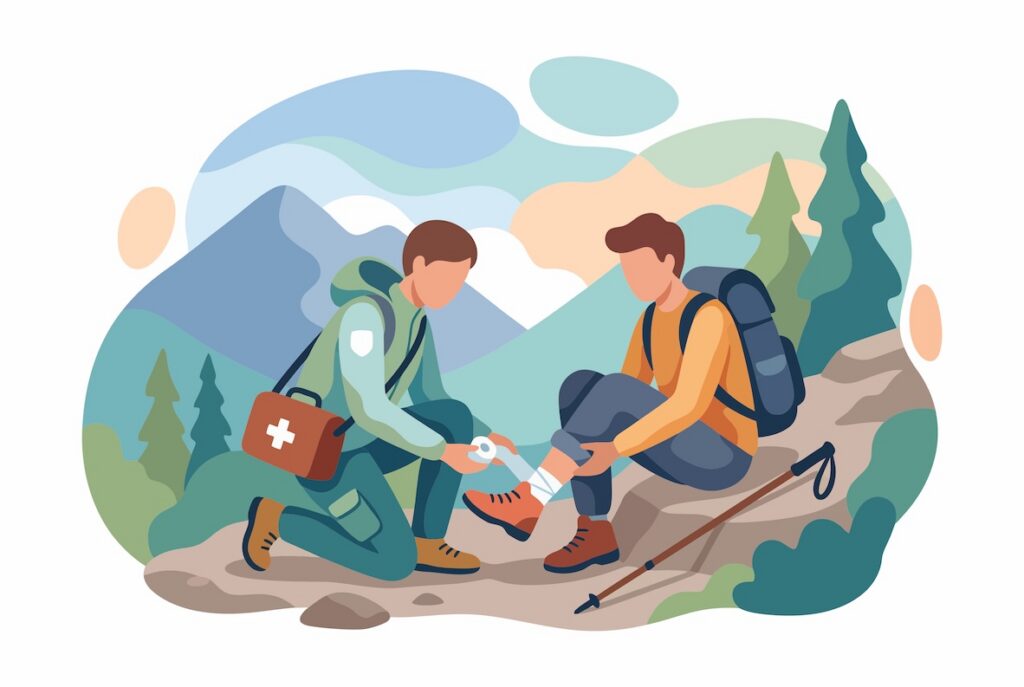
Out in the backcountry, whether you’re dealing with a twisted ankle or a full-blown medical emergency, clear, calm communication can make the difference between an effective treatment/evacuation and a chaotic situation that spirals out of control.
This post presents guidance on how to communicate with sick or injured parties in emergency settings and keeping patients and their loved ones informed and reassured, so you can get on with the business of providing effective medical treatment.
Getting Up to Speed on Therapeutic Communication Fundamentals
Therapeutic communication is simply a set of best practices for helping patients feel heard, understood, and a little less freaked out when they’re sick, injured, exhausted, and at wit’s end. And in the backcountry, that matters — a lot.
It starts before you even say a word. Nonverbal cues are the equivalent of making a good first impression. These can be broken down into three categories:
- Facial expressions: A calm, reassuring look (possibly with a smile) or an appropriately concerned demeanor, sets the tone immediately.
- Eye contact: Enough to show you’re present, not so intense that you come across as an interrogation lamp.
- Body position: Get on their level. Kneeling beside someone is better than looming over them as though you’re about to deliver some really bad news.
As soon as you start talking, you can begin to use the verbal communication techniques, below, which can cover most of your interactions:
- Facilitation: Encourage the patient to talk. Simple prompts such as, “Tell me what happened” can be very effective.
- Pausing: Wait long enough for the patient to consider and answer any questions. Silence isn’t awkward — it gives someone time and space to think and respond.
- Reflection: Repeat or rephrase what they said, so they know you’re listening and understanding. Reflection also helps you confirm your own understanding of the situation.
- Clarity: Present information and instructions clearly and succinctly.
Now that you know how to act and what to say (the do’s), here are a few counterproductive techniques to avoid (the don’ts):
- Don’t provide false hope: Don’t promise more than you can deliver. Patients can sense it.
- Don’t ask leading questions: Let them tell their story — don’t steer it. You’ll get more and better information by asking open-ended questions and letting the patient do the talking.
- Don’t use medical jargon: Read the room and use language your patient will understand.
How you communicate can calm a patient or make things worse. When it comes to communication, aim for calm and clear plainspoken English.
Knowing What to Do and Say (and What Not to): Real-World Examples
If you’re struggling to find the right words, you’re not alone. This is one of the hardest aspects of caring for patients, especially in high-stress backcountry situations. The good news is that a calm, confident manner and a few simple phrases (simple language in general) can go a long way toward building trust and assuring patients. The following examples highlight how to behave and what to say (and what not to) in some common scenarios. They enable you to communicate with confidence when it matters most:
- For a frightened child: Instead of immediately asking medical questions, the emergency medical technician (EMT) kneels beside the child and speaks calmly: “Hi, my name is Todd. I’m here to help you. Can you tell me where it hurts?” This shows non-verbal communication through body position and verbal communication through facilitation and clarity.
- For elderly fall patient: An older patient may be embarrassed or scared after a fall. The EMT pauses and allows time for answers instead of rushing: “Take your time. Can you tell me what happened before you fell?” This demonstrates pausing and open-ended questioning.
- For a person having difficulty breathing: They’re in respiratory distress and may struggle to answer quickly. The EMT uses short, clear questions and reassures them without giving false hope. “Focus on slow breaths for me. Are you having chest pain?” This highlights clarity and avoids overwhelming communication.
- For dealing with an intoxicated individual: Instead of arguing or using sarcasm, the EMT stays calm and respectful. “I understand you’re upset. We just want to make sure you’re safe.” This approach reinforces professionalism and therapeutic communication even during difficult situations.
- For a family member who’s on scene: A worried family member may interrupt repeatedly. The EMT acknowledges the concern while keeping the assessment moving. “I know you’re worried about her. I’m going to ask a few quick questions so we can help her as fast as possible.” This demonstrates calm communication and scene control without sounding dismissive.
Here’s an example of what to avoid: Instead of saying, “You’re going to be completely fine,” which may convey false hope, say something like, “We’re going to take good care of you and get you to the hospital.” This provides reassurance without promising an outcome that may be a little too rosy.
At the end of the day, emergency medical technicians (EMTs) and wilderness medicine providers are here to save lives and limbs and help people feel better. You can’t do that without first understanding what’s going on, and that understanding comes from clear and effective communication. Presenting a calm and confident demeanor, asking the right questions, listening closely, and building trust in the moment are just as important as any clinical skill. When you communicate well, you don’t just gather information — you set the stage for better care and better outcomes.
Now, about that little dust-up I may have caused over which rock ’n’ roll band is No. 1: I’d like to know what you think. Please send us an email to share your opinion. Is it The Beatles? The Rolling Stones? Led Zeppelin? The Go-Go’s? Talking Heads? The Bangles?
Oh, and if you have any tips or stories to share that illustrate the value of communicating clearly with patients in a medical emergency, we’d love to read those, too! You can reach us at info@ncoae.org.
– – – – – – –
About the Author: Todd Mullenix is the Director of Wilderness Medicine Education at The National Center for Outdoor & Adventure Education(NCOAE) in Wilmington, North Carolina.
TALK TO US
Have any further questions about our courses, what you’ll learn, or what else to expect? Contact us, we’re here to help!
Leave a comment