

Safety Should Always Come First During a Wilderness Medicine Scene Size-up
June 10, 2026
Safety first! That short phrase has been a mantra in outdoor adventure and education for as long as I can remember. In wilderness medicine, safety is also, and obviously, a top priority.
It’s counterintuitive, but the first person you need to protect is yourself, along with other members of your team. Rushing into a scene without first assessing potential hazards can quickly turn one victim into two or three or more.
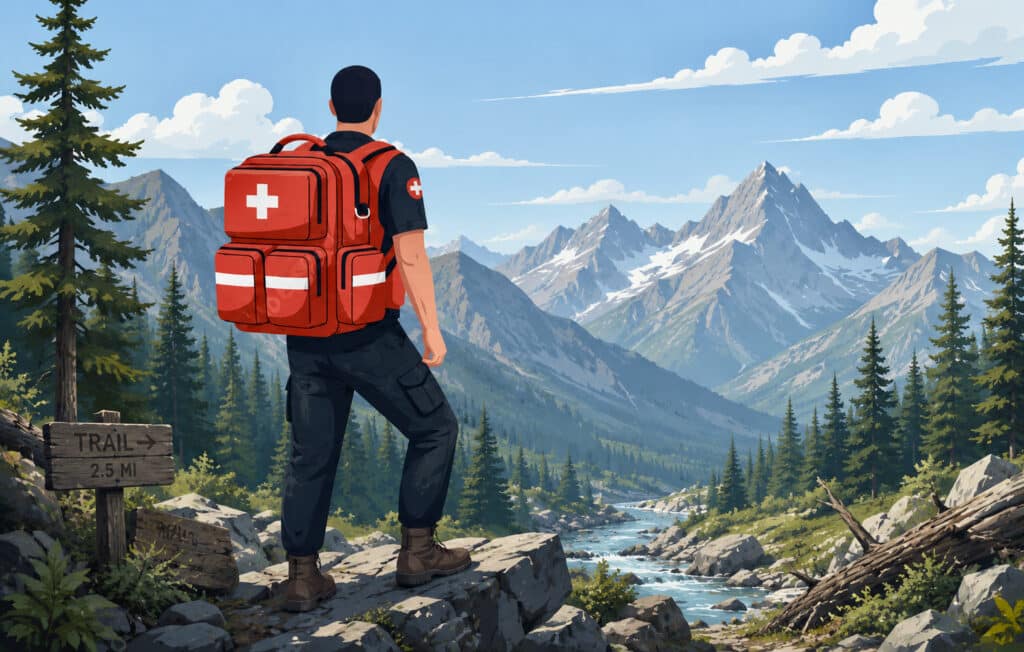
As part of our emergency medical service (EMS) training here at The National Center for Outdoor & Adventure Education (NCOAE), we are taught to perform a scene size-up before treating ill or injured parties in any situation. We check for hazards, try to determine the mechanism of injury (MOI) or nature of illness (NOI), count patients, and determine whether additional equipment or resources are needed. An example? Grabbing up a cervical collar and stretcher for spinal motion restriction (SMR).
See our previous post “The Role of Assessment in Wilderness Medicine” for additional details.
One component of the scene size-up that’s often overlooked is the safety check. We’re all taught to check a scene for safety, but few of us perform a thorough one. Even fewer perform a secondary safety check to verify that the scene is still safe after we meet the patient. In my experience, many EMS clinicians have become complacent about their situational awareness. They’re not as vigilant about what’s going on around them and the posture and demeanor of their patients and any bystanders during treatment and transport.
We need to be better at scene safety and continued safety, and we must maintain better situational awareness both on scene and during transport. Your safety matters, and that’s what this blog post focuses on.
What Could Possibly Go Wrong?
Whatever the scene, wilderness and urban first responders face potential threats to their safety. In a wilderness setting, for example, you could be dealing with:
- Unstable terrain
- Falling objects (rocks, trees/branches)
- Lightning
- Dangerous wildlife (bears, venomous snakes, mountain lions)
- Hazardous plants
- Wildfires
- Flash floods
In an urban setting, you need to be aware of:
- Traffic
- Violence
- Fire/smoke
- Electrical hazards
- Structural dangers (unstable buildings, collapsing roofs)
- Infectious diseases
And in all situations, every patient and bystander poses a potential threat, whether it’s from being uncooperative, intoxicated, or panicked individuals who may behave erratically and unpredictably.
Just this past April, in Akron, Ohio, a paramedic was punched in the face during a call. According to investigators, family members became upset that the patient was not being taken to a hospital. They followed paramedics outside, and one of the family members punched a paramedic in the face while he was sitting in an ambulance.
In another incident that same month, two New York City EMTs were hospitalized after they were attacked by an emotionally disturbed man they were trying to assist. Three other EMTs were also injured trying to force their way into the building to help their assaulted colleagues.
Back in February, in Illinois, an A-TEC Ambulance EMT and semi-truck driver were injured in a multi-vehicle secondary crash on westbound I-90 in Hoffman Estates. Paramedics were on the scene treating patients from a previous collision when the secondary accident occurred. A tractor-trailer struck one of the crashed vehicles pushing it into the EMT.
Surveying the Scene
It takes only a few seconds to stop, look, listen, and smell before rushing to the patient. Those few seconds can prevent a serious injury or worse.
Here’s how to pause and scan the entire area:
- Look up and all around for loose rocks, hanging limbs, or (in a building) structural hazards.
- Check the ground for unstable terrain, slippery surfaces, hidden holes, steep drop-offs, downed powerlines, and other hazards.
- Assess the weather and water conditions for immediate threats and the potential for changing conditions.
- Consider whether wildlife, fire, lightning, or other environmental factors may pose a threat.
Engage other senses:
- Listen for rushing water, falling debris, rustling vegetation, or approaching vehicles.
- Smell for smoke, fuel, or hazardous chemicals.
- Observe the emotional tone of the scene and the behavior of loved ones and bystanders.
Ask yourself whether you have the proper personal protective equipment (PPE), which may include medical gloves, eye protection, face mask, along with other resources you’ll need to proceed in reasonable safety.
Keep in mind that a scene is rarely static. What appears to be safe during an initial assessment may become dangerous minutes later. Risk assessment is a continuous process.
Maintain Situational Awareness Throughout the Call
Situational awareness is the habit of constantly monitoring your surroundings and adjusting your actions and behavior as conditions change. It involves sharing attention between your patient and your surroundings and asking, “What’s changed around me?”
Tunnel vision is a common trap when caring for a patient. The more focused you are on treatment, the easier it is to miss emerging threats. Make it a habit to pause after completing a task — lift your head, and scan your surroundings. Reassess weather conditions, terrain, water levels, wildlife activity, and your team’s location. Consider evacuation routes if something doesn’t feel right. Trust your instincts.
By following situational awareness best practices, the most important person on every call is the wilderness first responder or EMT who gets home safely at the end of a trip or shift. Whether you’re responding on a city street or miles into the backcountry, the scene is rarely completely safe. Take a moment to identify any immediate threats that need to be addressed and maintain continuous situational awareness. These are the most effective tools you have to protect yourself and your crew and, ultimately, to deliver life-saving care to your patients.
To learn more about scene safety, read “The Role of Assessment in Wilderness Medicine” here on the NCOAE blog. Ready to take the next step? Explore our Wilderness Medicine trainings or EMT courses, available in both self-paced and immersive formats to fit your learning style and schedule.
– – – – – – – – –
About The Author: David Young, EMT, is the Director of Emergency Medicine Education at The National Center for Outdoor & Adventure Education(NCOAE) in Wilmington, North Carolina.
TALK TO US
Have any further questions about our courses, what you’ll learn, or what else to expect? Contact us, we’re here to help!
Leave a comment