

Understanding the Roles of Special Teams in Emergency Medical Services (EMS)
July 22, 2026
In American football, every team in the National Football League (NFL) has an offensive unit, a defensive unit, and a small collection of what are often referred to as “special teams.”
These special teams take the field only during critical moments of the game, such as kickoffs and returns, punts and returns, field goals and extra points (after a touchdown.)
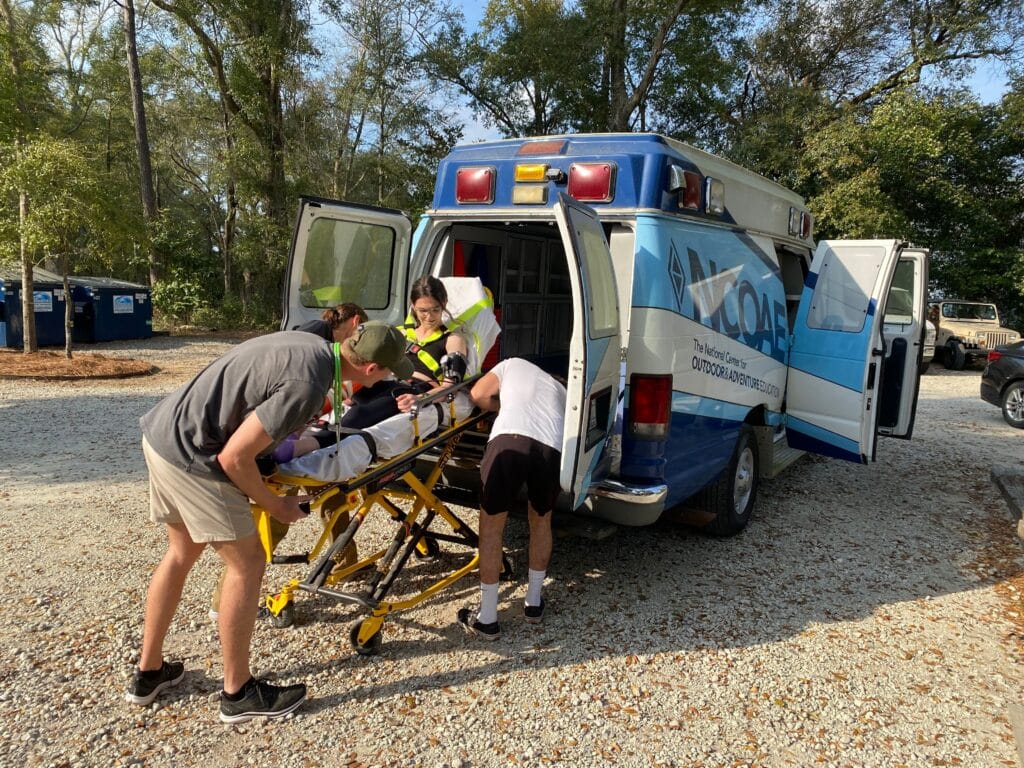
Likewise, emergency medical personnel have conventional teams that respond to ordinary emergencies and they have special teams that are called in to respond to unique, often high-risk situations. These EMS special teams have advanced training and equipment for the following tasks:
- Responding to disasters, such as earthquakes, hurricanes, and tornadoes
- Airlifting seriously ill or injured patients to medical facilities
- Responding to situations involving hazardous materials (HazMat)
- Conducting search and rescue (SAR) operations
- Providing tactical EMS (TEMS) during high-risk law-enforcement operations
- Rescuing people from dangerous scenes (technical rescue)
- Rescuing people in or around water (water rescue)
- Caring for ill or injured parties in backcountry settings (wilderness medicine)
This post brings you up to speed on these EMS special teams and the additional training and certification needed to qualify for each.
Disaster Medical Assistance Team (DMAT)
Disaster Medical Assistance Team members (DMATs) provide medical care in response to large disasters, such as earthquakes, tornadoes, hurricanes, and other mass-casualty events. These teams are organized at the federal level and deploy anywhere they’re needed across the United States.
Most clinical DMAT members must have a current, unrestricted certification or license as one of the following (hours listed are estimates across the U.S., but may vary by state and level):
- EMT: 240 hours
- Advanced EMT (AEMT): 300–500 hours
- Paramedic: 1,000–1,800 hours
- Registered Nurse (RN): 2–4 years
- Physician: 11–15 years
- Physician Assistant (PA): 2–6 years
- Nurse Practitioner (NP): 6–10 years
- Respiratory Therapist (RT): 2–3 years
- Pharmacist: 6–8 years
Flight EMS
Flight EMS involves transporting critically ill or injured patients by rotor-wing (helicopter) or fixed-wing (airplane) aircraft. Medical helicopters are used every day to transport patients from ambulance scenes to specialized hospitals or trauma centers and even from hospital to hospital in special cases. Fixed-wing medical transport typically fly greater distances than helicopters, picking up and dropping off their patients at airports, transferring patients from or to an ambulance crew.
Required certifications to be a flight paramedic or flight nurse typically include:
- State paramedic certified (National Registry certification usually preferred): 1,000–1,800 hours
- Flight Paramedic-Certified (FP-C): 3–6 months for experienced medics
- Critical Care Paramedic-Certified (CCP-C): 3–6 months for experienced medics
- Registered Nurse (RN) or, preferably, a Bachelor of Science in Nursing (BSN): 2–4 years
- Certified Flight RN (CFRN): 2–6 months for experienced nurses
- Certified Transport RN (CTRN): 2 years
- Trauma Certified RN (TCRN): 2 years
- Basic Life Support (BLS): 8 hours
- Advanced Cardiovascular Life Support (ACLS): 16 hours
- Pediatric Advanced Life Support (PALS): 16 hours
- Prehospital Trauma Life Support (PHTLS) or International Trauma Life Support (ITLS): 16–24 hours
Hazardous Materials (HazMat)
HazMat teams respond to and manage incidents involving dangerous substances or chemicals. An example might be a tanker truck carrying concentrated sulfuric acid tips over on a highway, spilling the corrosive chemical across the roadway and into a nearby drainage ditch. The leaking acid creates dangerous fumes, threatens nearby waterways, and poses a serious risk to motorists and first responders.
Local EMS and firefighters would establish a safety perimeter, treat the injured from a safe distance, and close the highway. The HazMat team would then come in to assess the situation, monitor air quality, stop the leak, neutralize and contain the spill, decontaminate exposed people and equipment, and coordinate the safe removal and disposal of the hazardous material.
Certifications for members of HazMat teams typically include:
- Firefighter I: 3–9 months
- Firefighter II: 6–9 months
- Driver/Operator (Pump): 6 months
- HazMat Operations: 48 hours
- HazMat Technician: 80 hours
- HazMat Incident Commander: 24 hours
- Hazardous Waste Operations and Emergency Response (HAZWOPER): 40 hours
Some fire departments may require more certifications.
Search and Rescue (SAR)
SAR teams locate and rescue lost and/or injured victims, such as missing hikers or people stranded or injured in the wilderness. Urban SAR (USAR) teams also help find and rescue victims from structural collapse; for example, in the aftermath of an earthquake. Many SAR teams were deployed to find missing people in Western North Carolina after Hurricane Helene devastated that region.
Requirements vary by state and department but typically include:
- Basic Life Support/CPR: 8 hours
- EMT, AEMT, or paramedic: Typically, 240 hours for EMTs, 300–500 hours for AEMT, or 1,000–1,800 hours for paramedics
- Wilderness First Aid (WFA): 16 hours
- Wilderness First Responder (WFR): 80 hours
- Basic Search and Rescue: 60 hours
- Lost Person Behavior: 16 hours
- Search Tactics: 16–55 hours
- GPS and Land Navigation: 16–30 hours
- Map and Compass Navigation: 8–32 hours
- Search Management: 60 hours
- Helicopter Safety: 24–32 hours
- Evidence Preservation: 16 hours
- Missing Person Operations: 48–60 hours
- Rope Rescue Awareness: 8 hours
- Rope Operations: 51–61 hours
- Rope Technician: 120 hours
- Confined Space Rescue: 40–48 hours
- Structural Collapse Rescue: 100 hours
- Trench Rescue: 64 hours
- Vehicle & Machinery Rescue: 48–58 hours
- Swiftwater Rescue: 8–40 hours
- Flood Rescue: 16–48 hours
More specific training may be required for some SAR and USAR teams.
Tactical EMS (TEMS)
Tactical medics are EMS professionals (typically paramedics) who provide medical care in high-threat, law-enforcement environments where conventional EMS crews cannot operate safely. They may be on SWAT teams or may help during active shooter incidents or other law enforcement situations in which having a specially trained medic is not only useful but necessary.
Certification requirements typically include:
- Paramedic: 1,000–1,800 hours
- BLS, ACLS, PALS: 8 hours for BLS, 16 hours for ACLS, and 16 hours for PALS
- PHTLS or ITLS: 16–24 hours
- Tactical Emergency Casualty Care (TECC): 16 hours
- Tactical Combat Casualty Care (TCCC): 16–40 hours
- Basic Law Enforcement Training (BLET): 20–22 weeks
Some fire departments may require additional certifications.
Technical Rescue
Technical Rescue involves saving people in dangerous situations; for example, rescuing an injured climber from a high rock face or stabilizing the remaining structure of a collapsed building and rescuing the people trapped inside.
Certification requirements typically include:
- Firefighter I: 3–9 months
- Firefighter II: 6–9 months
- Rope Rescue: 24–40 hours
- Confined Space Rescue: 40–48 hours
- Structural Collapse Rescue: 100 hours
- Trench Rescue: 64 hours
- Vehicle & Machinery Rescue: 48–58 hours
- Swiftwater Rescue: 8–40 hours
- Flood Rescue: 16–48 hours
- Wilderness Search & Rescue: 60 hours
- Surface Water Rescue: 36–48 hours
- Ice Rescue: 8–16 hours
More specific training may be required for SAR and USAR teams.
Water Rescue
When emergencies happen on, in, under, or near water, where standard EMS crews often can’t reach victims safely or quickly enough, water rescue teams are often called in. Situations like these often involve saving people from a flooded area or “swift water” — a swollen river or flash flood. They may also involve larger bodies of water, such as lakes and oceans, and dive rescue.
Certification requirements typically include:
- Surface Water Rescue: 36–48 hours
- Swiftwater Rescue: 8–40 hours
- Boat Operations: 16–24 hours
- Ice Rescue: 8–16 hours
- Dive Rescue Basic: 60 hours
- Dive Rescue Advanced: 68 hours
Some fire departments may require more certifications.
Wilderness EMS
Wilderness EMS provides medical care for victims in remote environments.
Many SAR team members are also trained in wilderness medicine. They can go into the wilderness and find victims, provide care and continue care as the victim(s) are walked or carried out of nature back to civilization. One example may be a hiker on a trail down in a ravine or gorge who experiences chest pain and faces a possible heart attack. This patient will need to be treated when found, stabilized, and then carried out of the bush — a process spanning several hours and a great number of additional people to support the operation.
Certification requirements may vary greatly but typically include:
- BLS: 8 hours
- EMT, AEMT, RN, physician assistant, or physician
- Wilderness Medicine Training
- WFA: 16 hours
- WFR: 80 hours
- Wilderness EMT (WEMT): 26–32 Days
- Wilderness Advanced First Aid (WAFA): 40 hours
- Wilderness Advanced Life Support (WALS): 36 hours
- Advanced Wilderness Life Support (AWLS): 16–20 hours
SAR training may also be required.
As in the NFL, EMS special teams aren’t called into action on every play, but when they are, the outcome can hinge on their unique expertise. Whether rescuing victims from swift water, mitigating a hazardous chemical spill, providing medical care during an active shooting, or performing a technical rope rescue, these highly trained specialists bring capabilities that go far beyond those of a standard ambulance crew. Their advanced training, specialized equipment, and ability to operate in high-risk environments make them an indispensable part of modern emergency medical services, ready to respond when ordinary simply isn’t enough.
If you’d like to improve your special team skills for emergency medicine, have a look at our emergency medicine and wilderness medicine training courses.
– – – – – – – – –
About The Author: David Young, EMT, is the Director of Emergency Medicine Education at The National Center for Outdoor & Adventure Education (NCOAE) in Wilmington, North Carolina.
TALK TO US
Have any further questions about our courses, what you’ll learn, or what else to expect? Contact us, we’re here to help!
Leave a comment